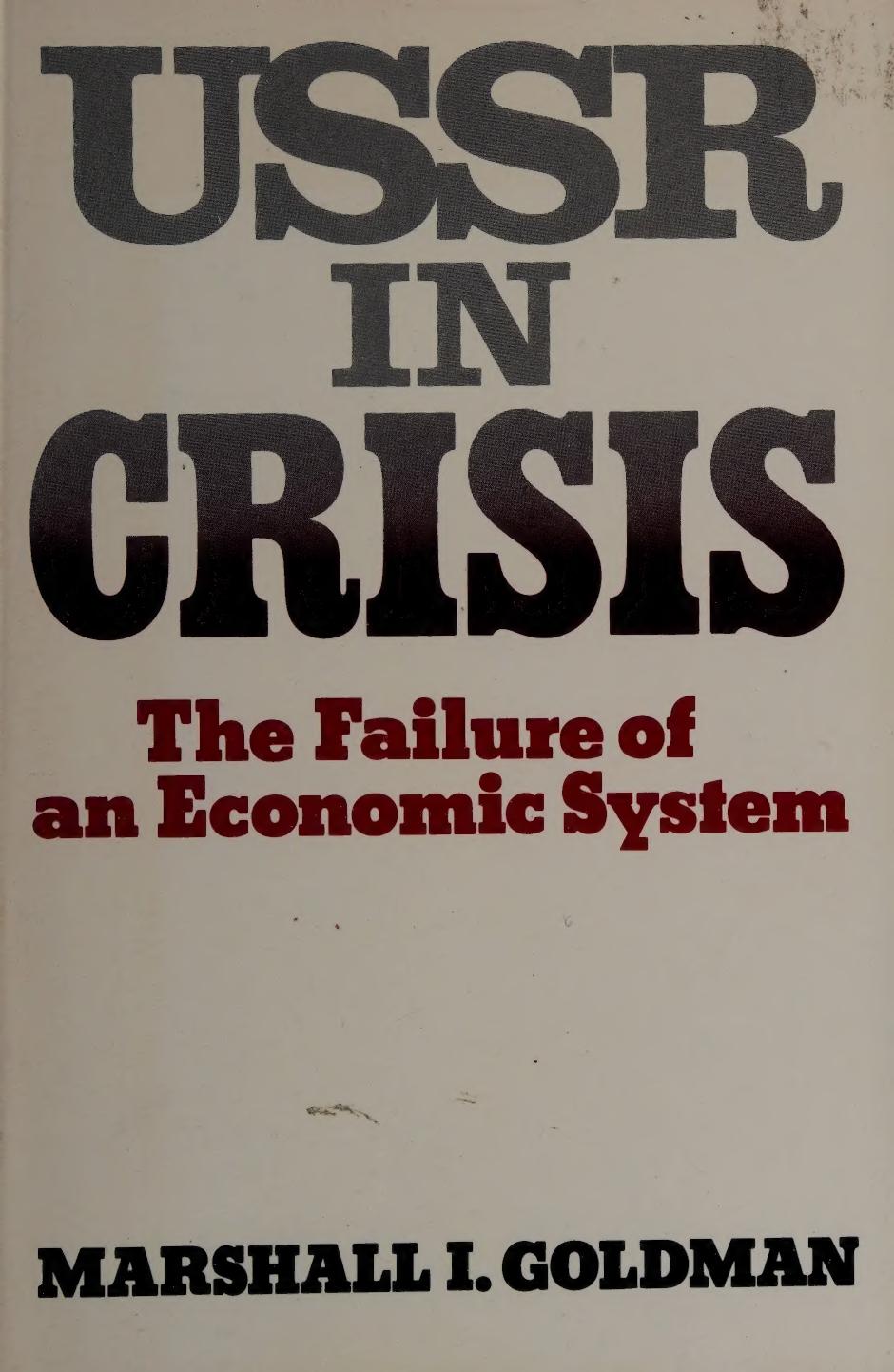

Outstanding US economist Marshall Irwin Goldman (1930-2017) wrote a groundbreaking book U.S.S.R. in Crisis: The Failure of an Economic System, 1983, where he revealed some shortcomings of the Soviet economy and predicted their future complications. At the same time, he made certain conceptual and factual errors in this treatise. Let’s review them in detail. By the way, the book’s restricted Russian edition was published in USSR, 1984, to be distributed primarily among the Soviet leaders, senior economists, intelligence community, etc. Apparently, its ideas influenced destructive agenda of the Mikhail Gorbachev’s perestroika to dismantle socialism in order to restore capitalism.

On page 15, Professor Goldman points out that “it must be remembered that private and state serfdom encompassed almost one-third of the entire Russian population, a much larger percentage of the country’s population than was affected in the United States. Moreover, serfdom existed throughout Russia, not just in one region“. This observation by the astute scholar implicitly shows an inconvenient truth, which was reluctantly acknowledged by his Soviet counterparts, that slavery in the USA was not as widespread as serfdom in the Russian Empire. Moreover, the noun “serfdom” sounds mildly hypocritical comparing with the outspoken, down-to-earth term of “slavery“. On the page 16, the US researcher uncovers the grim reality of Soviet purges, carried out primarily by Joseph Stalin’s henchmen Genrikh Yagoda and Nikolai Ezhov, which caused severe HR shortages: “In the 1930’s, the government of the U.S.S.R. had the youngest leadership of any major country“. On page 24, the author sketches out the tragic background of Russian history to explain centuries-old war-mongering feelings of its population’s overwhelming majority, conveniently disguised as defensive measures: “Given what sometimes seems to be the almost continual stream of marauders passing through or threatening the country, the Russians have come to accept some extraordinary restraint on their individual lives, usually in the name of national defense“.
On page 73, Professor Goldman makes it clear, why Soviet peasants suffered heavy losses during intensive industrialization of the Soviet Union in 1929-1934: “If the revolution had occurred in an industrialized state as Marx had predicted, instead of an agricultural one like Russia, there would have been no need to woo the peasantry, no need to evoke a sense of betrayal, and no need to put such pressure on agriculture in order to finance the accumulation needed for heavy industry“. On page 78, he once again convincingly demonstrates that agricultural investments were a top priority in the Soviet budget policy in order to support domestic producers: “According to a CIA calculation, in 1977 the Soviets invested the equivalent of $78 billion in agriculture, compared to $11 billion in the U.S. Given the large percentage of total investment that went into Soviet agriculture, that is not such a surprising figure. This large sum reflects not only the lower labor productivity of Soviet agriculture, but what appears to be the urgent effort by the Soviets to free themselves from costly agricultural imports“. On page 79, the American scholar elaborates still further on different goals of agricultural investments in USA and USSR. Taking into account harsh weather conditions in the Soviet Union and its vast territory, the author says that “according to CIA estimates, approximately 75 per cent of the money invested in American agriculture is used for increasing the stock of machinery. In the Soviet Union, the comparable figure is about 50 per cent. At the same time, about 40 per cent of Soviet agricultural investment goes for construction, compared to only about 25 per cent directed to construction in the United States. Thus a disproportionate share of Soviet investment goes to massively conceived projects, particularly irrigation and drainage. Since extreme weather changes, especially droughts, do account for major crop losses on a regular basis in the Soviet Union, such projects do make some sense“.
On page 80, Professor Goldman cites grave environmental issues, caused by poorly designed Soviet agricultural techniques: “For every acre of land added to agricultural use because of irrigation in Central Asia, an acre disappears, most often because of salination. In many cases the same exchange results when new land is irrigated but equally valuable land is lost when comparable acreage is flooded to create a reservoir behind the irrigation dam. Because of overcropping and poor agricultural techniques, the Soviets have also been troubled by periodic dust storms“. On page 84, he explains, how the industrial scale of Soviet agriculture affected the size of its machinery: “Almost all Soviet agricultural machinery is designed for large scale operations. Therefore, anything the individual peasants use on their own plots, more often than not, is homemade. Occasionally, equipment is stolen from the collective sector and cannibalized in order to “downsize” it to the more restrictive confines of the peasant plot“. On page 92, the US scholar points out that the Soviet Union is not a classical empire with clear-cut differences between its metropole and colonies: “The point is that the Soviets have not significantly exploited their outlying regions, nor treated them merely as raw material colonies. It is probable that on the whole, more has been taken out than has been put in, but the flow is not as one-sided as it is in the usual colonial relationships in the noncommunist world“. On page 101, the American researcher mentions serious demographic problems in USSR, telling about: “the Soviet practice of waiting to have a baby until a woman is in her mid-30 ’s and has had several abortions. This postponement is due to the housing shortage, as well as to general economic strains“. On page 182, Professor Goldman finally remarks, as though having an insight of tragic events to take place in the future: “Now there is a sense that economic life may actually have been better in the past and that the future may be even worse… The present situation is bad, but the consequences of a reform may be even worse“.
Of course, like any book, this one also has its typos, factual errors, etc. On page 73, the American scholar confuses two novels by great writer Mikhail Sholokhov — And Quiet Flows the Don and Virgin Soil Upturned. The former deals with the WWI and the Russian Revolution, while the latter narrates about the forceful collectivization. In doing so, the author misspells Mr. Sholokhov’s last name: “Soviet literature itself, including Sholokov’s Quiet Flows the Don, graphically depicts not only the human suffering, but the slaughter of what was once their own livestock by the peasants“. On page 108, he mistakenly asserts that Chechen and Ingush ethnic groups were not allowed to restore their autonomous republic, citing “the plight of the Chechen-Inguish and Crimean Tatars, people who in World War II were driven from their homes and not allowed to return“. On page 112, the US researcher misplaces Estonia, which is a neighbour of Finland and Sweden, to the vicinity of Poland: “Since Estonia was so close to Poland…“
 (0)Dislikes
 (0)
(0)
Discover more from TriLingua Daniyar NAURYZ
Subscribe to get the latest posts sent to your email.