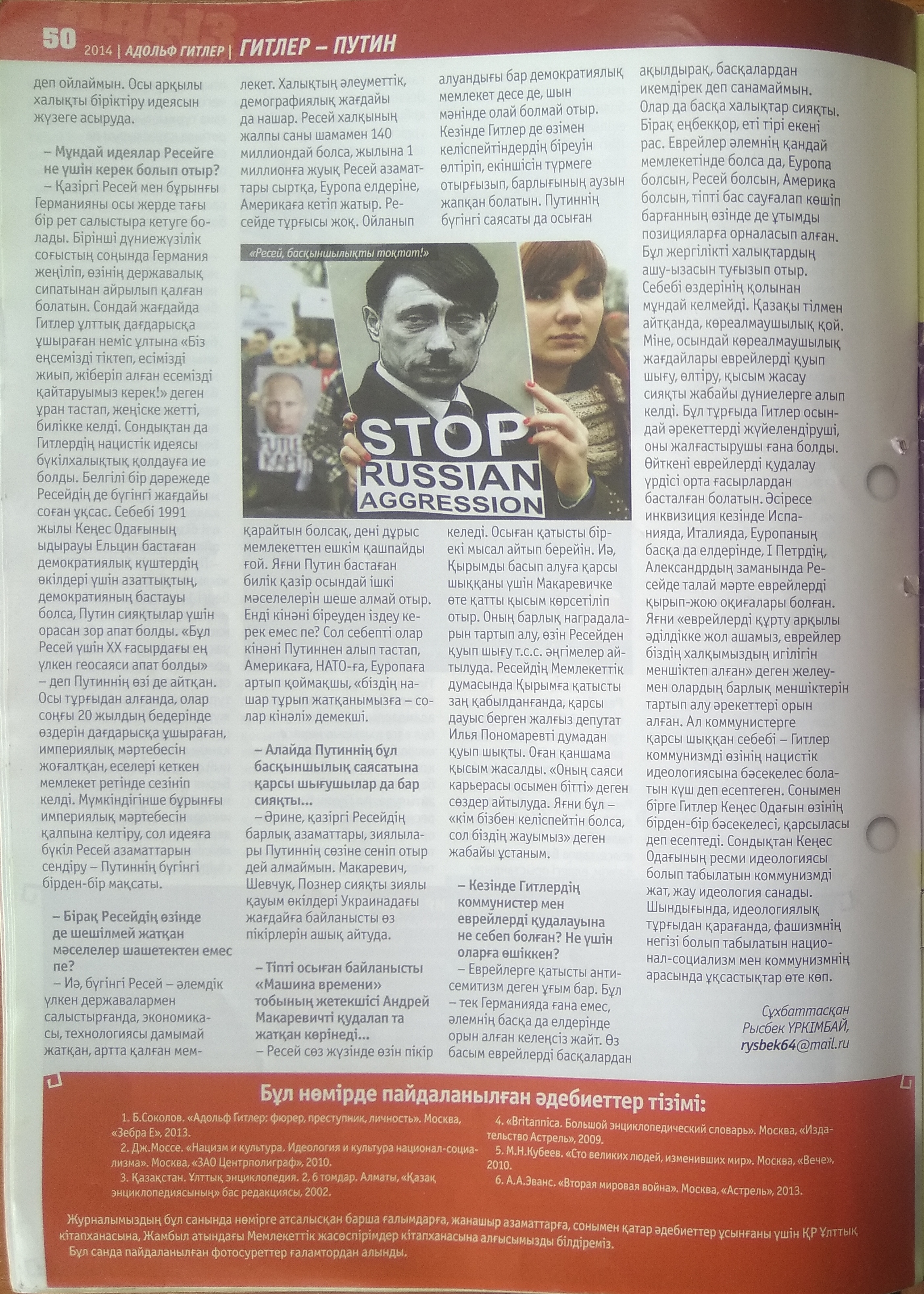

One of the leading diplomatists of Central Asia and Kazakhstan is also a prominent political scientist of the vast region. It was a remarkable display of truth-seeking discourse, when Rasul Zhumaly outspokenly proclaimed in the aftermath of the Crimea Annexation that president of Russia Vladimir Putin sometimes is worse than the head of Nazi Germany Adolf Hitler. The bold statement by Mr. Zhumaly, who bravely stands out among mostly pro-Russian Kazakh politicians, was spelled out in his interview to a Kazakh journalist Ryssbek Urkymbai, published in a biographical magazine Legendary Person‘ eighth issue of 2014. This issue was dedicated to the 125th birthday of the great German politician. The interview has an eye-catching title: In a way, Putin is Worse Than Hitler. No wonder that this particular issue stirred a resentment among pro-Russian forces in Kazakhstan and abroad. The magazine’s editor-in-chief Zharylqap Qalybai was fined. Many of the issue’s 25 200 copies were confiscated and destroyed. Incidentally, Mr. Zhumaly served as the Kazakh ambassador to Lybia, 2006-2007. Nowadays, he is the Kazakh Ambassador to Lebanon. So, let us review highlights of the interview.

The Kazakh diplomatist compares the annexation of Crimea by Russia, 2014, to the annexation of Sudetenland by Germany, 1938. In both cases, supposed discrimination of Russian and German compatriots was a pretext to invade Ukraine and Czechoslovakia respectively. However, according to Mr. Zhumaly, the Russian dictator has gone to more extremes than his Austria-born counterpart. Mr. Hitler basically aimed to protect those, who were of the German ethnic origin. But, Mr. Putin’s goals have been far-reaching: he has ostensibly strived to defend Russian-speaking community, regardless of their ethnic origin. The authoritarian leader of Russia employed more advanced imperialistic techniques in the annexation of Crimea. Namely, quick distribution of Russian passports and a makeshift Crimean referendum to vindicate the illegal capture of the foreign territory. Of course, all these measures run contrary to Ukrainian and international laws alike.

Under Mr. Putin, as Mr. Zhumaly further elaborates, Russia has widely used double standards in its foreign and domestic policy. For example, Kremlin puts forward a right of nations to self-determination in order to vindicate its annexation of Georgian and Ukrainian regions. But, for example, Russia has refused to grant independence to the breakaway republic of Chechnya, who has suffered an atrocious bloodshed of two wars. Other Russian regions, like Tatarstan, has been also denied their right to self-determination. The Kazakh diplomatist points out that Russia has set up an enormous propaganda machine to meddle in internal affairs of its neighbours by falsely accusing them as Fascists and Russophobes like it has been a case with Ukraine, who has resisted Russia’s expansion. On the other hand, Russian authorities themselves have fostered domestic skinhead, neo-Nazi movements to intimidate its coloured minorities.

Mr. Zhumaly says that the German strongman made use of popular feelings in Germany, who was defeated in WWI, to restore its status as a great power. Mr. Putin has used principally the same approach. However, the modern Russia, struggling to catch up with developed countries, would hardly achieve its goal to revive the Soviet Union’s might, which collapsed in 1991. A few dissenters, like pop singers Andrei Makarevich, Yuri Shevchuk, and a maverick politician Yuri Ponomarev, have been merely dwarfed by the overwhelming majority of war supporters in Russia. As for Mr. Hitler’s hatred for Jews and Communists, the Kazakh diplomatist goes on, there were different causes of such dislikes. Personally, Mr. Zhumaly doesn’t regard the Jews as superior to other ethnic groups in terms of mental faculties. But, he admits that considerable success of hard-working, enterprising Jews have given rise to envy among certain nations. So, the Austria-born politician simply channelled the disappointment and anger of ordinary Germans, who experienced hard times of the post-WWI nationwide humiliation, into anti-Semitism. As for his anti-Communist stance, it was born out of rivalry with Communism as an alternative ideological force. However, according to the Kazakh diplomatist, there are many similarities between Nazism and Communism.
 (0)Dislikes
 (0)
(0)
Discover more from TriLingua Daniyar NAURYZ
Subscribe to get the latest posts sent to your email.