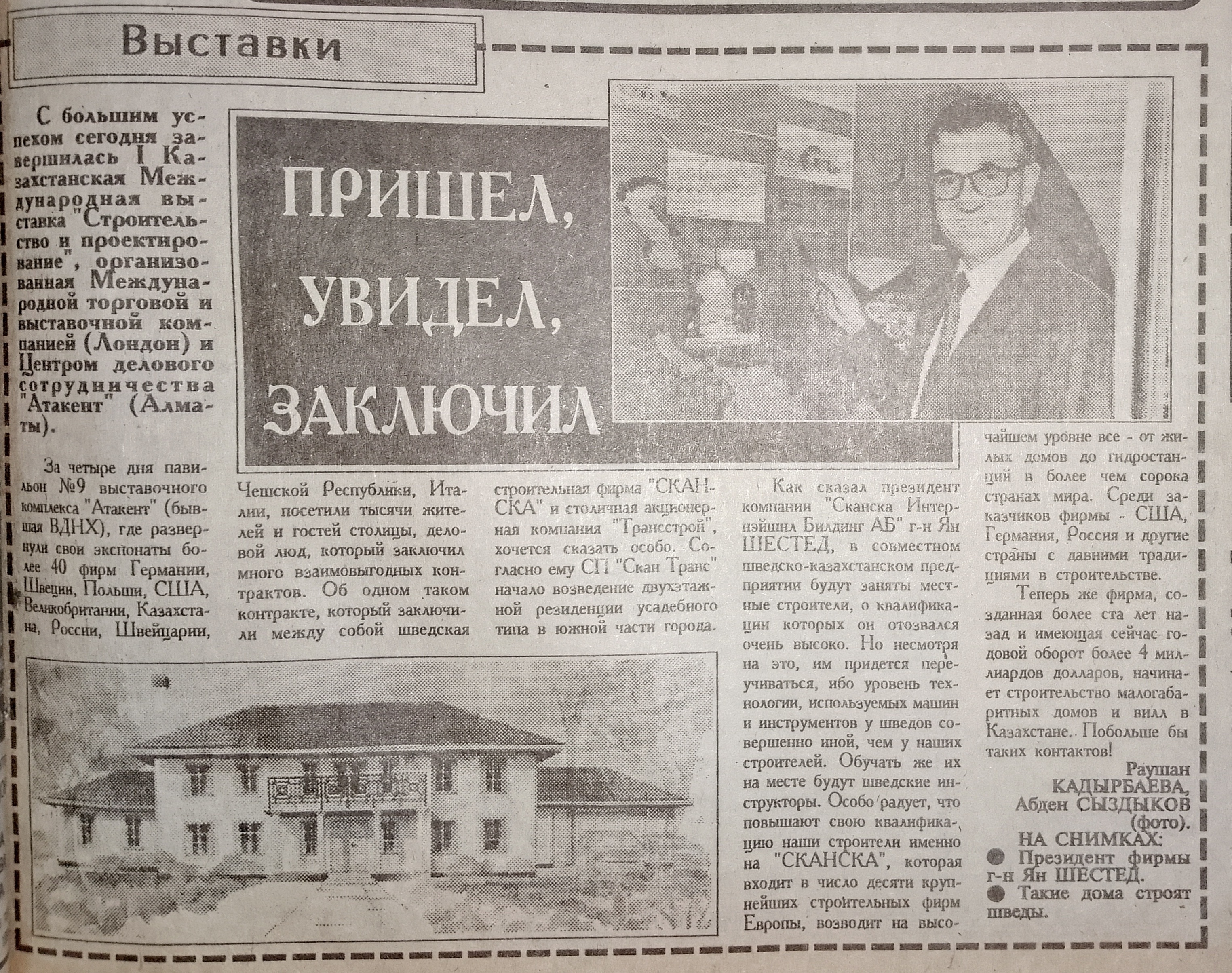

It was a privilege to me — the 16-year-old beginner at journalism — to prepare an interview with Jan Sjöstedt, president of Skanska International Building AB, which was published on September 23, 1994, in a Kazakh newspaper The Evening Almaty. I was responsible for research and data gathering for the interview, which was entitled quite pompously as Veni, Vidi, Strike a Deal.

Mr. Sjöstedt participated in the first international civil engineering exposition KazBuild in Almaty, where representatives of Germany, Poland, USA, Italy, Switzerland, and other countries took part. He said that Skanska carries out various construction projects: from apartment buildings to hydroelectric power plants. The Swedish businessman told us that the company is one of the ten leading civil engineering firms in Europe with the annual turnover of some $4 billion. At that time, they set up a joint Swedish-Kazakh company. Namely, a two-storey villa in the southern part of Almaty City was under construction. He praised the expertise of local civil engineers, but higher standards of Swedish machinery and technology would require them to pass additional training under the supervision of Swedish specialists.
Unfortunately, promising contacts with Skanska didn’t turn out to be a large-scale project. Nowadays, the construction market of Kazakhstan has been flooded with Chinese, Russian, and Turkish companies, who usually offer lower-quality products and services. Perhaps, they are more comfortable with corruption requirements of local authorities than their Swedish counterparts. Anyway, it is regrettable that the Sweden’s civil engineering firm, which, as a rule, provides more advanced technology and better salaries than its Chinese, Russian, and Turkish competitiors, has left our construction market. It was a result of not only commercial circumstances, but political ones as well. Because, since the 2010s China and Russia have made an effort to jointly discourage Western companies from entering a huge market of Central Asia and Kazakhstan, which they consider a domain of Sino-Russian influence.
 (0)Dislikes
 (0)
(0)
Discover more from TriLingua Daniyar NAURYZ
Subscribe to get the latest posts sent to your email.